Zanga-Zanga: A Placard, A People, A New Nigerian Future
The word Zanga-Zanga is the Hausa name for what is commonly known in English as a placard. Across Northern Nigeria, Hausa speakers have long used the term to describe a board, sign, or written display used to communicate a message in public spaces. At Shutter for Change, this indigenous expression has been adopted not simply as a name, but as a philosophy , a distinctly Nigerian approach to civic engagement, cultural expression, and nation-building.
The Zanga-Zanga is a public art initiative that uses the traditional placard as a tool for social reflection, cultural representation, and national dialogue. It is built on the belief that art should not be confined to galleries, museums, or digital platforms. Art belongs in the streets, markets, schools, parks, and public spaces where people live their daily lives.
Unlike conventional placards used solely for protest or advertising, the Zanga-Zanga serves as a mobile platform for ideas. It carries messages that inspire reflection, encourage civic responsibility, promote unity, and invite citizens to imagine a better future for Nigeria.
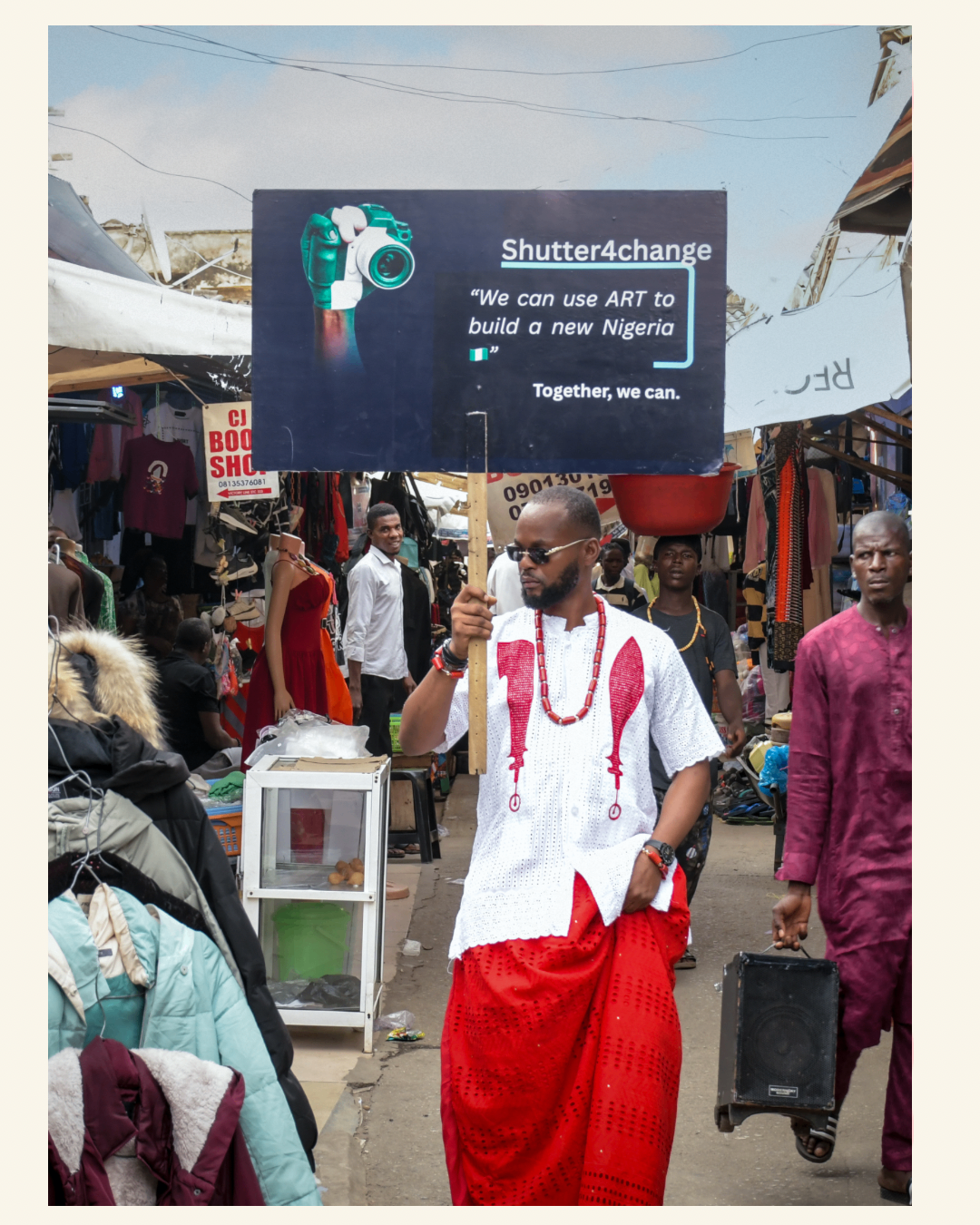
At the heart of the movement is a symbolic ritual. Every Zanga-Zanga is carried by a bearer who represents a particular cultural or professional identity. The bearer does not appear in ordinary clothing. Instead, they are encouraged to wear traditional attire from their ethnic origin or professional attire that reflects their role in society.
This ritual transforms the bearer from a mere individual into a representative of a larger community.
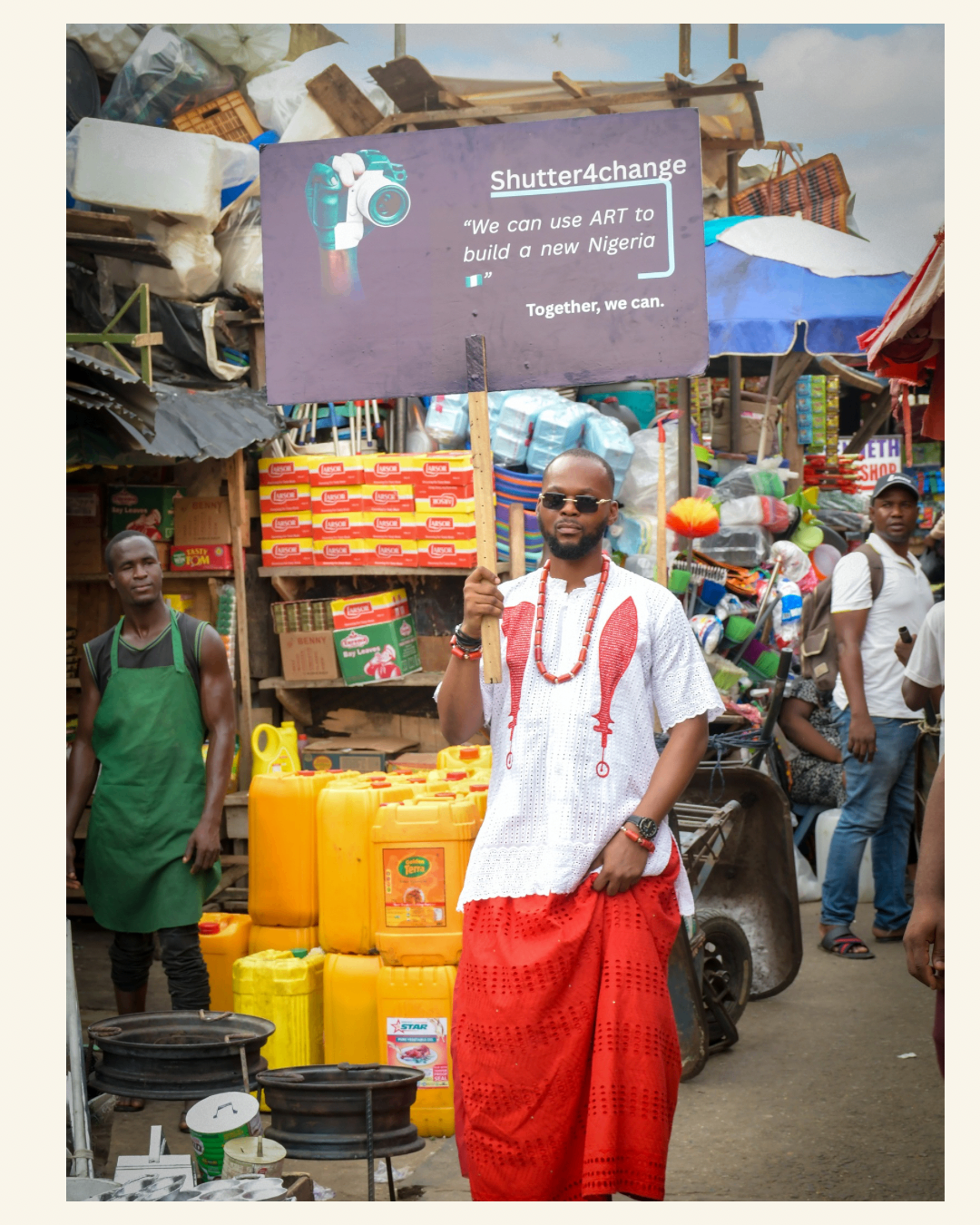
For example, when I carried a Zanga-Zanga through Utako Market while dressed in Benin traditional attire, I was not simply present as Nosakhare. I was symbolically present as a Benin man. My clothing communicated a cultural identity before a single word was spoken. It announced that the Benin people were part of the conversation about Nigeria's future. It demonstrated that ethnic identity can be a contribution to national unity rather than a barrier to it.
The same principle applies to every participant in the movement. An Igbo woman carrying a Zanga-Zanga in traditional attire represents the presence of the Igbo nation within the Nigerian project. A Yoruba elder represents Yoruba heritage. A Fulani youth represents Fulani culture. A Tiv farmer, an Ijaw artist, a Kanuri student, or an Efik entrepreneur each become visible symbols of the many peoples that make up Nigeria.
When professional attire is worn, the symbolism remains equally powerful. A teacher represents education. A doctor represents healthcare. A farmer represents food security. An engineer represents innovation. Through their appearance and participation, they affirm that every profession and every community has a role in building the nation.
This combination of message and identity is what makes the Zanga-Zanga unique.
Historically, placards have played important roles in artistic, political, and social movements around the world. They have been used to spread ideas, challenge injustice, mobilize communities, and inspire change. Their strength lies in their simplicity. They require no electricity, no internet connection, and no special technology. A placard can speak to thousands of people in a single day simply by occupying public space.
The Zanga-Zanga builds upon this historical tradition while adding a uniquely Nigerian dimension. It recognizes that Nigeria's greatest strength is its diversity. By encouraging participants to visibly represent their ethnic and professional identities, the movement creates opportunities for Nigerians to encounter one another not as strangers, but as partners in a shared national journey.
The movement therefore serves multiple purposes. It is art because it transforms public space into a living exhibition. It is education because it stimulates conversation and reflection. It is cultural preservation because it celebrates indigenous identities. And it is civic engagement because it encourages citizens to take ownership of the future of their country.
At Shutter for Change, the Zanga-Zanga is more than a placard. It is a symbol of participation.
Every message written on a Zanga-Zanga is an invitation to think.
Every bearer is a representative of a community.
Every public appearance is an act of citizenship.
And every encounter is a reminder that Nigeria's future will not be created by a single tribe, region, religion, or profession. It will be created by millions of citizens from different backgrounds who recognize themselves as co-creators of a shared national destiny.
Shutter for Change uses photography, storytelling, public art, and civic engagement to promote unity, strengthen national identity, and contribute to the healing of Nigeria's collective trauma.
Join the conversation